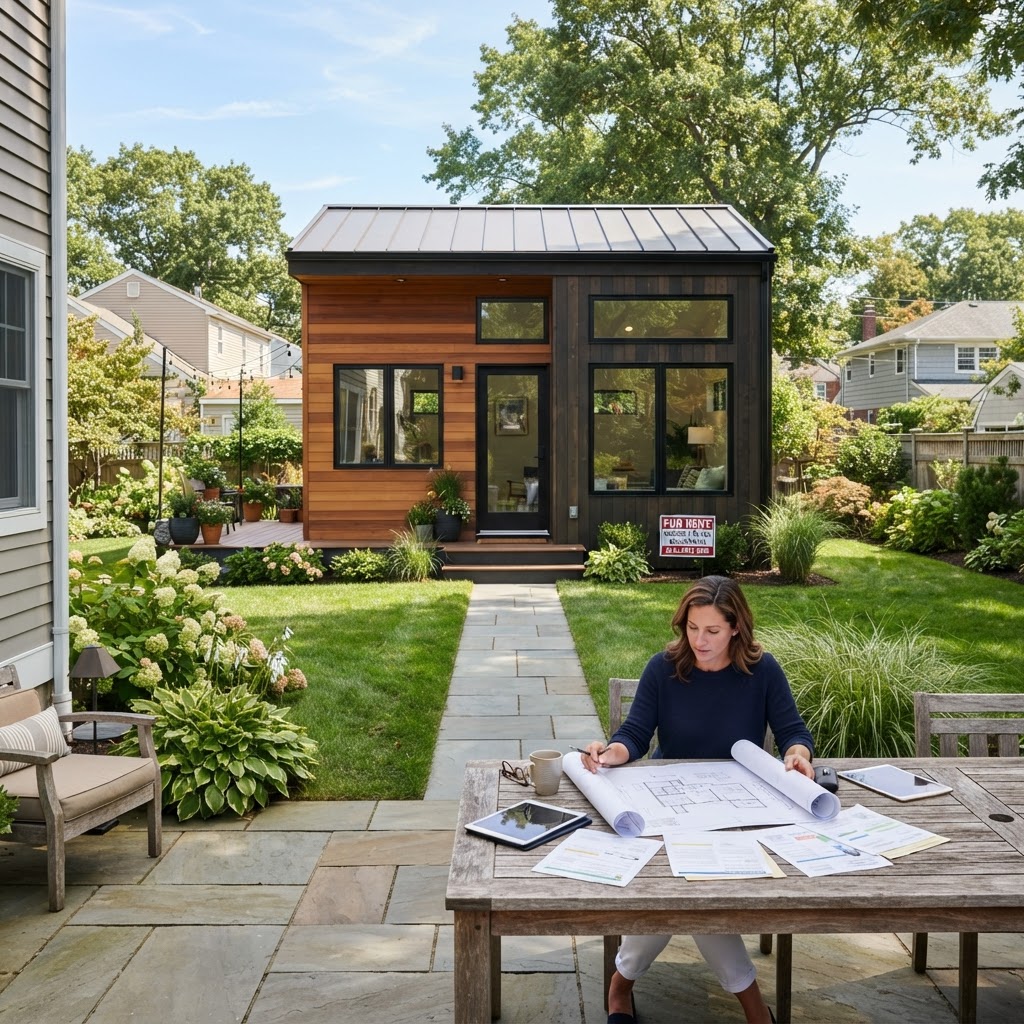
The backyard may be the only part of a property that has not yet been assigned a job. The house provides shelter. The driveway holds the cars. The garage holds everything except, somehow, the cars. The backyard usually provides grass, a grill and an ongoing argument about whether the shed needs to be cleaned.
An accessory dwelling unit can give that land a new purpose. It may provide rental income, reduce the cost of housing a family member, support an aging parent or create a flexible second home that serves several generations. That leads to the question homeowners naturally ask: Can an ADU pay for itself?
The honest answer is: sometimes — but not by magic, and not in only one way. The financial return depends on the total project cost, financing, local rules, taxes, insurance, utilities, maintenance and how the family will use the home. A good analysis measures both income and expenses, but it also measures costs the family may avoid.
There is more than one kind of return
Rental income
Where the municipal ordinance and the family's plans allow a long-term rental, an ADU can create monthly income from land the homeowner already owns. That income may offset loan payments, taxes, utilities and maintenance. It can also help an older homeowner remain in the primary house or make the entire property more manageable for the next generation.
Rental income should be estimated conservatively. Use comparable legal rentals of similar size and condition, then subtract vacancy, repairs, insurance, utilities paid by the owner, management and a reserve for replacements. A number copied from a large apartment building is not automatically the right number for a backyard home, even if the internet says it with great confidence.
Avoided housing expense
An ADU used by a parent or adult child may not collect market rent, but it can still create financial value. The family may avoid or reduce the cost of a separate apartment, repeated moves, long-distance caregiving travel or a housing arrangement that charges a continuing monthly amount.
This comparison must be honest. Assisted living and group residences may include staffing, meals, transportation, programming, medication assistance or other services that an ADU does not provide. Housing and care belong on separate lines of the worksheet. If support staff will be needed in the ADU, include that cost rather than pretending the building itself knows how to provide care.
Long-term flexibility
A well-planned ADU may solve more than one problem over time. It can begin as a home for a parent, later house an adult child and eventually become a long-term rental where permitted. It may allow the property owner to move into the smaller home while another family member occupies the main house. One structure can have several useful lives.
That flexibility is financially meaningful because it reduces the likelihood that the family must build, move or renovate again every time life changes. The best return may not appear in a single year's cash flow. It may show up as options the family does not have to purchase later.
Property value
A legal second dwelling can make a property more useful to future buyers, especially those planning for multigenerational living or income. But an owner should not assume that every dollar spent will come back dollar for dollar at resale. Market demand, appraisal methods, neighborhood sales, construction quality and whether the ADU was properly approved all matter.
The word legal is doing a lot of work in that sentence. Permits, inspections and a certificate of occupancy are not paperwork to be dealt with later. They are part of the asset. An unapproved unit can become a problem during a refinance, sale, appraisal or insurance claim.
Build the real financial worksheet
The project budget should include more than the price of the home itself. A complete analysis accounts for the survey, architecture and engineering, municipal applications, permits, site preparation, demolition, foundation, utility work, drainage, delivery and set, exterior connections, finish work, landscaping, financing costs and a reasonable contingency.
The monthly analysis should then include the loan payment or lost investment return on cash, any increase in property tax and insurance, owner-paid utilities, maintenance, vacancy if rented and a reserve for larger replacements.
A practical formula: monthly rent or avoided housing cost, minus financing, taxes, insurance, utilities, maintenance, vacancy and any separately required care or support services.
Run at least three versions: a conservative case, a likely case and an optimistic case. If the project works only when every assumption behaves perfectly for twenty years, the spreadsheet is not a plan. It is a wish wearing reading glasses.
Public benefits are not a construction loan
Families of adults with disabilities should be especially careful here. New Jersey's Division of Developmental Disabilities describes home- and community-based services through the Community Care Program and Supports Program, as well as rental subsidies through its housing-assistance system. Those benefits are governed by eligibility and program rules.
A payment associated with a group residence, support service or rental voucher cannot be assumed to transfer to the construction or mortgage payment for a family-owned ADU. Whether a particular ADU can be an eligible rental or service setting depends on the resident, the ownership and lease structure, program requirements and approvals. Before including public funding in the budget, have the arrangement reviewed by the person's support coordinator and qualified benefits, legal and financial advisers.
The ordinance can change the economics
An ADU is financially useful only if it can be approved and used as planned. Teaneck, Maplewood and Montclair all permit ADUs in designated residential zones, but their rules are not identical.
For example, Teaneck's 2025 ordinance permits one ADU on qualifying detached single-family lots in the R-S, R-M and B-R zones, requires the owner to live in one of the two units, and requires one parking space in an existing driveway as tandem parking. Maplewood permits one ADU in specified residential zones and generally limits its size to 300 to 800 square feet and no more than 40 percent of the principal home's living area. Montclair's current standards generally use the same 300-to-800-square-foot range and 40-percent cap, while its 2025 amendment allows a detached ADU in R-1 and R-2 to reach up to 40 feet in either length or width, subject to the rest of the zoning code.
Those details affect design, bedroom count, rent potential, construction cost and even whether a particular model fits. That is why the financial analysis must begin with a property-specific feasibility review, not a generic promise that all backyards can do the same thing.
Could S-1786 make New Jersey more predictable?
Potentially. Senate Bill S-1786 is the current New Jersey proposal focused on broader ADU development. The first reprint would require municipalities with fewer than 9,000 people per square mile to allow compliant ADUs, while treating denser municipalities and towns with qualifying earlier ordinances differently. It would also establish standards addressing issues such as setbacks, parking, short-term rentals, application timing and utility connections.
As of August 12, 2026, the bill is pending in the Senate Budget and Appropriations Committee after being reported from the Senate Community and Urban Affairs Committee with amendments. It has not become law. Even if it is enacted, the current language would not make every ADU automatically legal on every lot in every town.
What it does show is direction. New Jersey is treating ADUs less like an odd zoning exception and more like a serious part of the housing conversation.
So, can it pay for itself?
If "pay for itself" means that rent covers every cost from the first month, the answer depends on the property, the financing and the local market. If it means that the ADU creates income, avoids other housing costs, adds long-term flexibility and leaves the family with a durable second home, the answer may be much more favorable.
The decision should not begin with a sales pitch. It should begin with three honest documents: a zoning and property feasibility review, a complete project budget and a conservative monthly comparison of the family's real alternatives.
At BLS ADU, we help homeowners start there. We review the property, explain the local process and determine whether the backyard can legally and practically support the plan. Then we can talk about the home itself — because the smartest financial move is not simply building an ADU. It is building the right ADU, on the right property, for a problem the family genuinely needs to solve.
This article is general educational information, not legal, tax, financial, benefits or construction advice. ADU approval and cost depend on the municipality, property, design and current law. Contact us to start with a property feasibility review.
