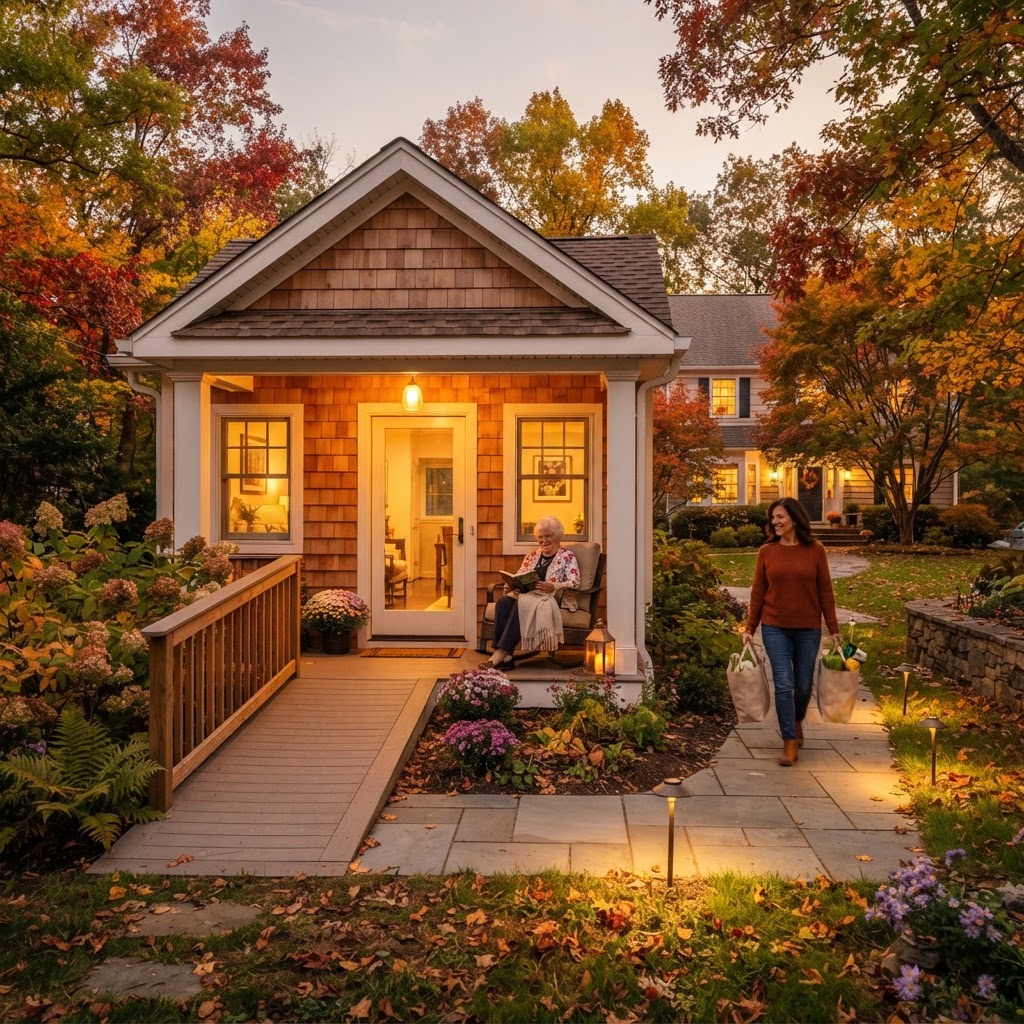
At some point, the question changes. It is no longer only, "What school, program or service is right for my child?" It becomes, "Where will my son or daughter live as an adult — and what will that life actually look like?"
For families of young adults with intellectual, developmental or physical disabilities, that question can carry a lot of weight. Everyone wants independence. Everyone also wants safety. The young adult may want a front door, a kitchen and a routine that are truly their own. The parents may want to know that help is close enough when it is needed, but not hovering over every bowl of cereal.
An accessory dwelling unit, or ADU, can create that middle ground. It is a smaller, independent home located on the same property as the main house. It is not the right answer for every person or every family. But when the property, the zoning, the finances and the support plan line up, it can turn a backyard into something much more valuable than a place to store a grill and a few stubborn weeds.
The question families are really asking
Most families are not simply looking for another building. They are trying to solve several needs at the same time: meaningful independence for their adult child, privacy for everyone, a reliable support network, stability as the parents age, and a home that can adapt as needs change.
Traditional options can force a family to choose one priority over another. A bedroom in the family home offers closeness but may not feel independent. A rental apartment can offer autonomy but may place the person far from the people who know them best. A group residence may provide services and community, but the location, roommates, staffing and timing are not always within the family's control.
An ADU does not erase those tradeoffs, and it does not replace a support plan. What it can do is give the family another choice: a real home with a private entrance and complete living facilities, with trusted support only a short walk away.
A home, not just a bedroom
That distinction matters. A bedroom says, "You live with us." A well-designed ADU can say, "This is your home, and we are nearby." The resident can choose when to invite family in, prepare a meal, decorate the living room, do laundry, host a friend or simply close the door at the end of the day.
Those may sound like ordinary things. That is exactly the point. Independence is often built out of ordinary choices repeated every day: what to eat, when to shower, where to put the blue chair and whether the thermostat should be set at 70 or an apparently tropical 76.
The home can also become a practical setting for skill-building. Depending on the person, that might include meal preparation, housekeeping, medication routines, transportation planning, budgeting or learning how to ask for help. Family members and paid support professionals can assist without making the primary house the center of every activity.
Independence does not have to mean isolation
The best version of independent living is not a young adult being left alone to prove a point. It is the right amount of freedom matched with the right amount of support. For one resident, a parent may check in once a day. Another may use remote monitoring, scheduled direct-support staff or overnight assistance. Someone else may need a connecting walkway, visual cues or a family member close enough to respond quickly.
Because the ADU is on familiar property, the resident can remain connected to neighbors, local programs, transportation, medical providers, a house of worship and the community routines they already know. The address stays familiar while the relationship to the home changes.
Design around the person — not around a label
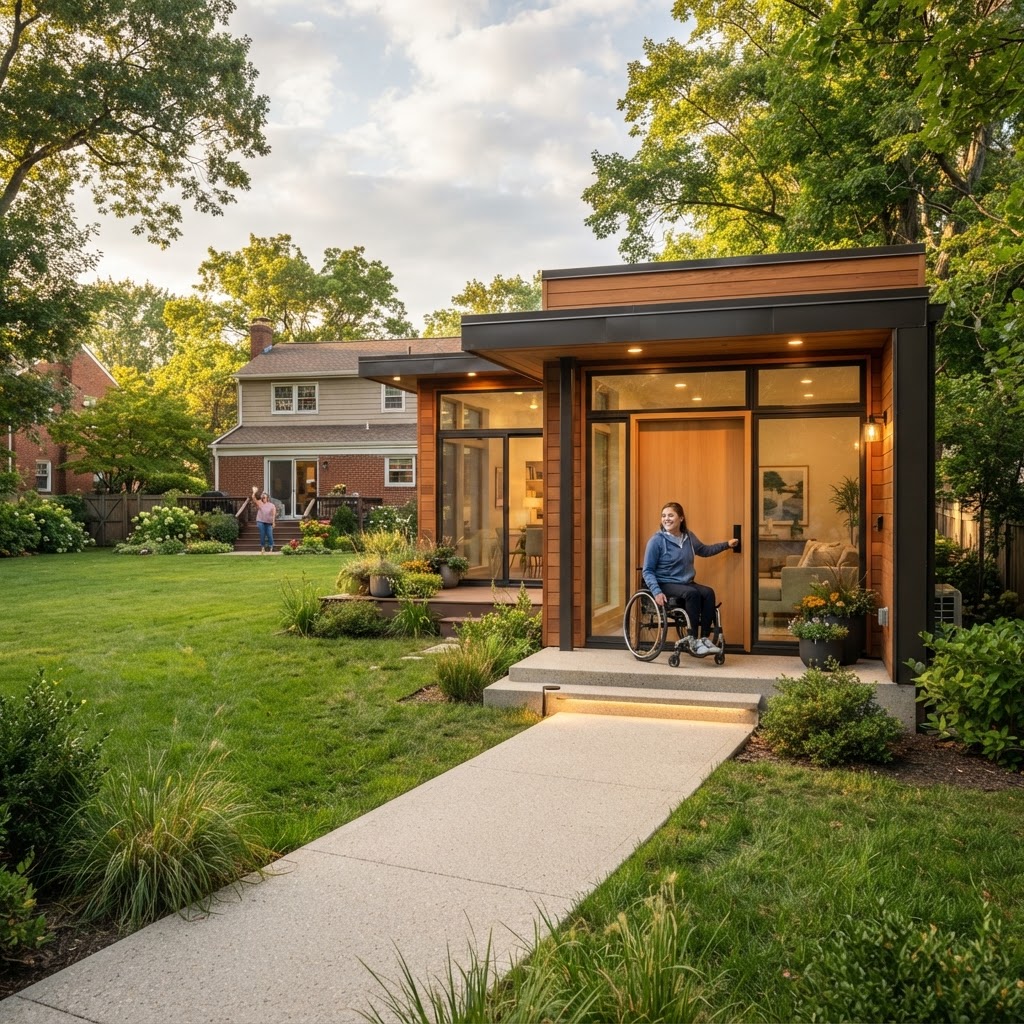
Accessibility is not one universal checklist. A wheelchair user, a person with limited vision and a person who becomes overwhelmed by noise may each need a very different home. The planning process should begin with the resident's daily routine: how they enter, cook, bathe, sleep, store belongings, receive support and respond in an emergency.
Possible features include a single-story layout, a no-step entrance, wider doors, clear turning areas, lever hardware, reachable controls, durable slip-resistant flooring, thoughtful lighting, simplified storage and a barrier-free shower. Sensory needs may point toward quiet mechanical equipment, dimmable lighting, predictable room layouts or a separate area where the resident can decompress.
A home can be accessible without feeling clinical. Our current options guide includes choices for siding, windows, doors, cabinets, counters and flooring, along with an available 60-inch barrier-free shower package that includes grab bars, a hand shower, a seat and roll-in entry. In plain English: it can work well and still feel like somebody's home.
New Jersey towns are beginning to recognize the need
The local zoning conversation is slowly catching up with the family conversation. Teaneck's 2025 ADU ordinance specifically recognized the difficulty people with disabilities can face finding adaptive housing near family and trusted support. The ordinance permits one ADU on qualifying single-family properties in designated zones and gives a five-percent floor-area increase when the ADU is fully accessible under New Jersey's Barrier Free Subcode.
Maplewood's code offers a similar five-percent floor-area increase for a fully accessible ADU. Maplewood permits one ADU in specified residential zones, subject to requirements that include owner occupancy and a general size range of 300 to 800 square feet, with the actual maximum also limited by the size of the principal home.
These are not statewide rules. They are examples of towns acknowledging that accessibility sometimes needs a little more room and a little more flexibility. Every property still needs its own zoning, survey, utility, drainage and building-code review.
Housing and support services are two different pieces
This is one of the most important financial and planning distinctions. An ADU provides the housing. It does not automatically provide supervision, transportation, personal care, employment support or behavioral services. Those supports must be planned separately around the resident.
New Jersey's Division of Developmental Disabilities administers the Community Care Program and Supports Program for eligible adults, and it also describes rental subsidies available through its housing-assistance system. Because those programs are governed by eligibility, service-plan and housing rules, a family should never assume that money used for a group residence or rental subsidy can simply be redirected into the mortgage or construction cost of a family-owned ADU. A support coordinator, benefits specialist and special-needs financial or legal adviser should review the proposed arrangement before the family relies on any public funding.
The right question is not, "Can an ADU replace every service?" It is, "Can this home become the stable platform around which the right services are built?"
The future of ADUs in New Jersey
There is also movement at the state level. The relevant proposal is Senate Bill S-1786. The current bill recognizes young adults, seniors and people with disabilities among the New Jersey residents who may benefit from more housing choices. As amended in June 2026, it would require qualifying municipalities with fewer than 9,000 people per square mile to allow compliant ADUs and would establish standards intended to make approvals more predictable.
As of August 12, 2026, S-1786 has been reported from the Senate Community and Urban Affairs Committee with amendments and referred to the Senate Budget and Appropriations Committee. It has not been enacted. The current version is not a blanket rule that would automatically make every ADU legal on every lot in every New Jersey municipality.
Still, the message from Trenton and from towns such as Teaneck, Maplewood and Montclair is becoming clearer: a second, smaller home can solve a very real family problem without requiring a family to leave the neighborhood it already calls home.
A practical first step
Families do not need to begin with a contract or a floor plan. They should begin with the person and the property. What does the young adult want? What support is needed today? What may change in five or ten years? Is a detached ADU permitted? Is there enough buildable area? Can utilities, drainage, access and parking work?
At BLS ADU, our first job is to help answer those questions honestly. If the property works, we can begin shaping a home around the family's goals. If it does not, it is better to learn that before money is spent on a beautiful plan that has nowhere legal to land.
For the right family, an ADU is more than a small house. It is a front door to adulthood — with the comfort of knowing that home is still only a few steps away.
This article is general educational information, not legal, tax, financial, benefits or construction advice. ADU approval and cost depend on the municipality, property, design and current law. Contact us to find out what's possible on your property.